Everything Saudi businesses need to know about Saudi Aramco’s Cybersecurity Compliance Certification — requirements, timeline, cost, and how to pass first time.

If your company does business with Saudi Aramco, you already know the word “CCC.” But if you’re new to the vendor ecosystem or preparing for your first audit, here’s everything you need.
What is Aramco CCC Certification?
CCC stands for Cybersecurity Compliance Certification. It is a mandatory requirement for all third-party vendors, contractors, and service providers working with Saudi Aramco. Without it, you cannot execute contracts, be registered as a vendor, or receive payments.
The certification verifies your organization meets the cybersecurity standards defined in **SACS-002** and the newer **SACS-210** — covering 33 security controls across 8 domains.
Who Needs It?
Any company that:
- – Bids on or holds Aramco contracts
- – Provides services to Aramco facilities
- – Accesses Aramco networks or data
- – Subcontracts to Aramco vendors

The 8 Control Domains
- | Domain | What It Covers |
- | Access Control | MFA, RBAC, privileged access management |
- | Email Security | SPF, DKIM, DMARC, anti-phishing |
- | Endpoint Protection | Antivirus, EDR, patch management |
- | Network Security | Firewall policies, segmentation |
- | Data Backup | Automated backups, tested recovery |
- | Security Policies | Written policies, incident response plans |
- | Awareness Training | Staff training, phishing simulations |
- | Vulnerability Management | Scanning, patch management |
How Long Does It Take?
With a guided partner like SirajTech, most organizations certify in **2–4 weeks**. Companies with existing controls may certify in as little as 2 weeks.
What Does It Cost?
Pricing depends on your current security posture. SirajTech’s end-to-end package starts at **SAR 8,000** and includes gap analysis, policy documentation, technical controls, and full audit support.
How SirajTech Gets You Certified
- 1. **Week 1** — Discovery and gap analysis across all 33 controls
- 2. **Week 2** — Policy writing and technical control implementation
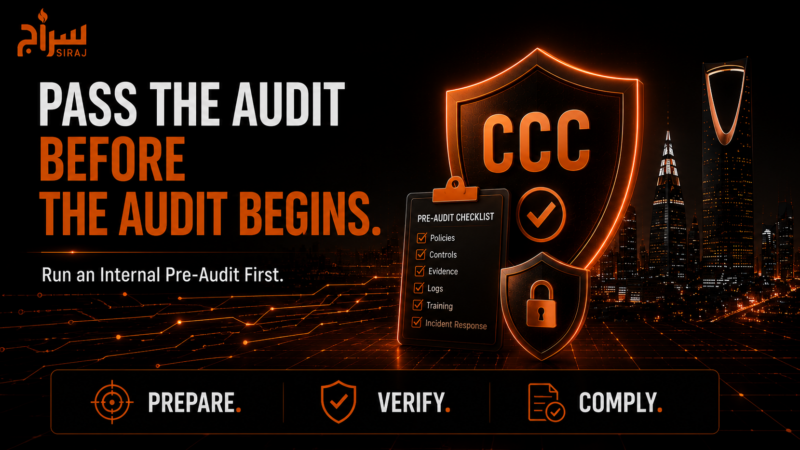
- 3. **Week 3** — Evidence collection and internal pre-audit
- 4. **Week 4** — Aramco audit submission and follow-through
Why Companies Fail (And How to Avoid It)
The 7 most common reasons for audit failure:
- 1. Missing or outdated security policies
- 2. No MFA enforced across the organization
- 3. Incomplete email security (SPF, DKIM, DMARC)
- 4. No documented backup testing procedures
- 5. Lack of vulnerability management program
- 6. Insufficient evidence collection
- 7. No staff awareness training records
SirajTech’s 98% first-time pass rate comes from addressing every single one of these before submission.
—
Ready to get certified?** [Contact SirajTech for a free gap assessment →](contact)