
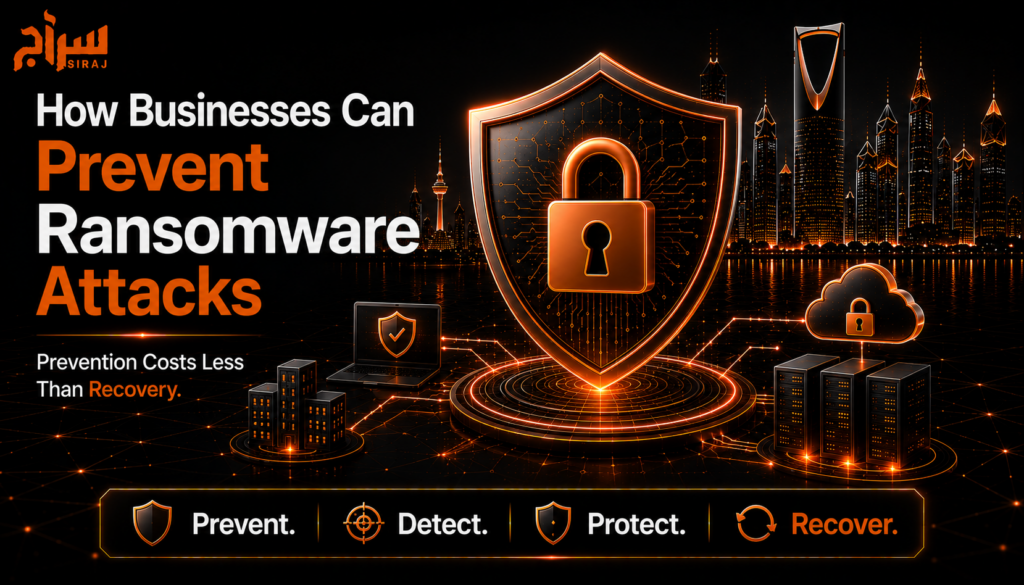
Our guide on ransomware recovery covers what to do in the first 24 hours after an attack has already succeeded — because preparation for that scenario matters regardless of how strong your prevention is. This article covers the other half: the specific controls that stop ransomware from succeeding in the first place, so that guide never needs to be used.
How Ransomware Actually Gets In
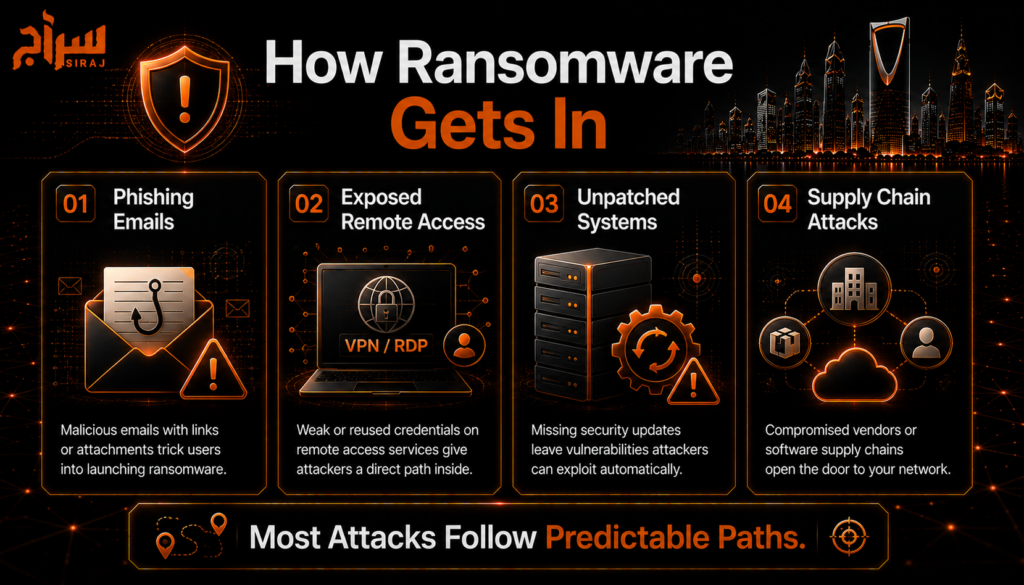
Ransomware rarely starts with some exotic, unstoppable exploit. The overwhelming majority of successful attacks trace back to a small number of well-understood entry points:
– **Phishing emails** with malicious attachments or links, tricking a user into executing the initial payload
– **Exposed or poorly secured remote access** (RDP, VPN) with weak or reused credentials, giving attackers a direct path in
– **Unpatched software vulnerabilities**, particularly in internet-facing systems, that let attackers in without any user interaction at all
– **Compromised third-party vendors or supply chain software**, where trust in an external provider becomes the entry point into your own environment
Every one of these has a specific, well-understood control that closes it — which is why ransomware prevention is less about exotic technology and more about consistent execution of known fundamentals.
The Controls That Actually Matter
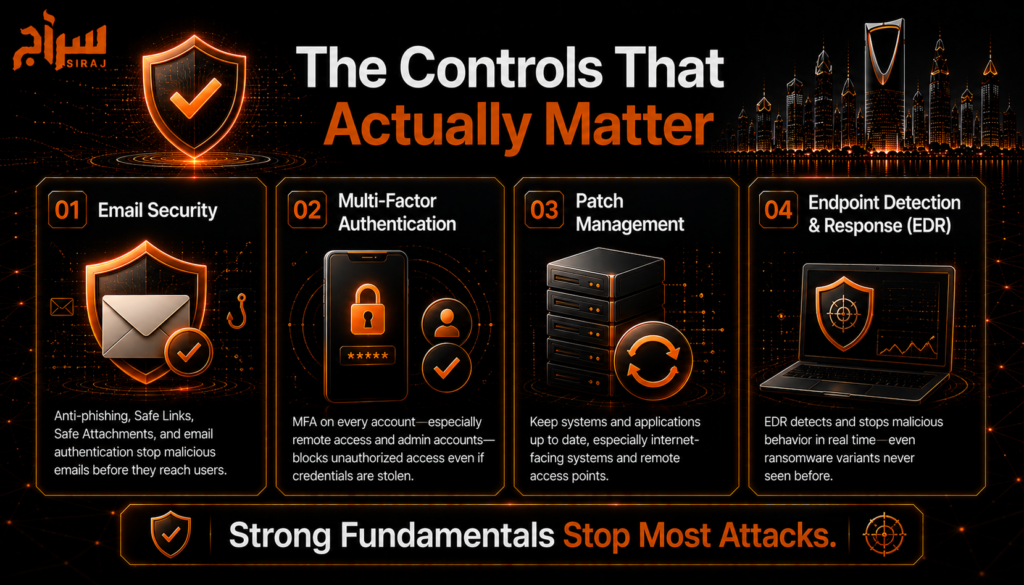
**Email security and phishing defense.** Since phishing remains the single most common entry vector, anti-phishing policies, Safe Links, Safe Attachments, and SPF/DKIM/DMARC email authentication directly reduce the volume of malicious email that ever reaches an inbox in the first place.
**Multi-Factor Authentication, everywhere.** MFA on every account — especially remote access and administrative accounts — closes the specific gap that “weak or reused credentials on exposed remote access” exploits. This single control blocks a large share of the credential-based entry attempts ransomware groups rely on.
**Patch management, prioritized by exposure.** Internet-facing systems and anything handling remote access need patching on a fast, disciplined cadence — these are the systems attackers scan for and exploit automatically, often within days of a vulnerability being disclosed. Internal systems matter too, but the urgency is different.
**Endpoint Detection and Response (EDR), not just antivirus.** Traditional signature-based antivirus catches known threats; EDR platforms (like Bitdefender GravityZone) add behavioral detection that can catch and stop ransomware’s actual *encryption behavior* in progress — often before meaningful damage occurs, even against ransomware variants the platform has never specifically seen before.
**Network segmentation.** If ransomware does get a foothold on one device, segmentation is what determines whether it stays contained to that device or spreads freely across the entire network — this is frequently the difference between a minor incident and a company-wide catastrophe.
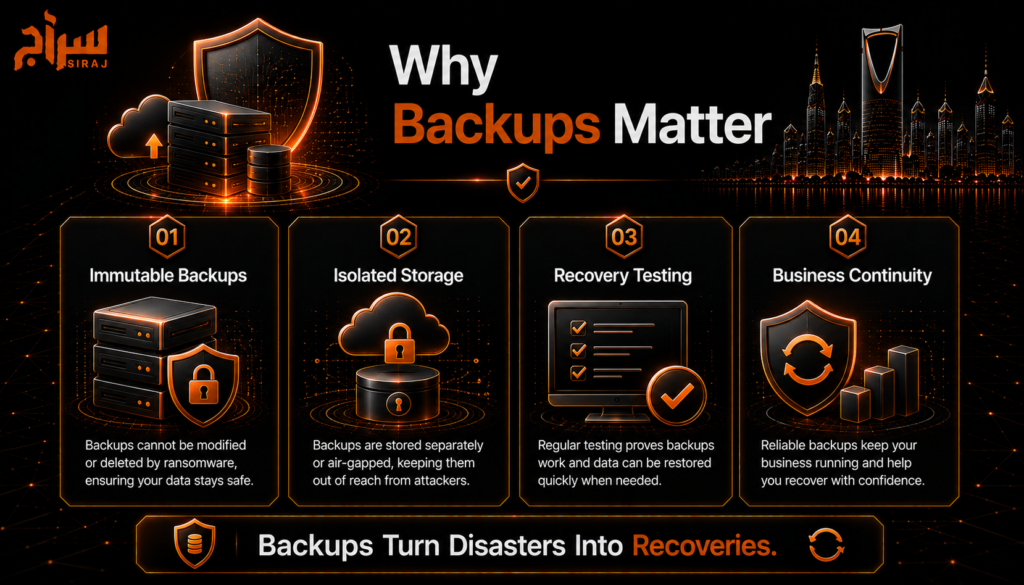
**Immutable, isolated backups.** This is the control that determines the *worst-case outcome* if every other control fails. A backup ransomware cannot reach or modify — because it’s isolated, air-gapped, or immutable — means a successful attack becomes a recovery exercise rather than an existential threat or a ransom negotiation. Modern backup platforms like Acronis https://www.acronis.com Cyber Protect Cloud combine this isolation with built-in ransomware detection specifically designed to halt an active encryption attempt and auto-restore affected files.
**The principle of least privilege.** Limiting what each user account and system can access reduces how far a compromised account can reach — an accounts-payable clerk’s account doesn’t need access to engineering file shares, and that restriction directly limits ransomware’s ability to spread through a compromised account’s normal access rights.
Why Prevention Investment Consistently Beats Recovery Cost
Every control above is meaningfully cheaper than the cost of an actual ransomware incident — lost productivity, potential ransom payment, incident response and forensics costs, regulatory notification obligations under Saudi PDPL if personal data was affected, and the reputational cost of the incident becoming known to customers or partners. This isn’t a close comparison: a properly configured set of preventive controls typically costs a fraction of even a single successful ransomware incident’s real cost to the business.
A Realistic Starting Sequence
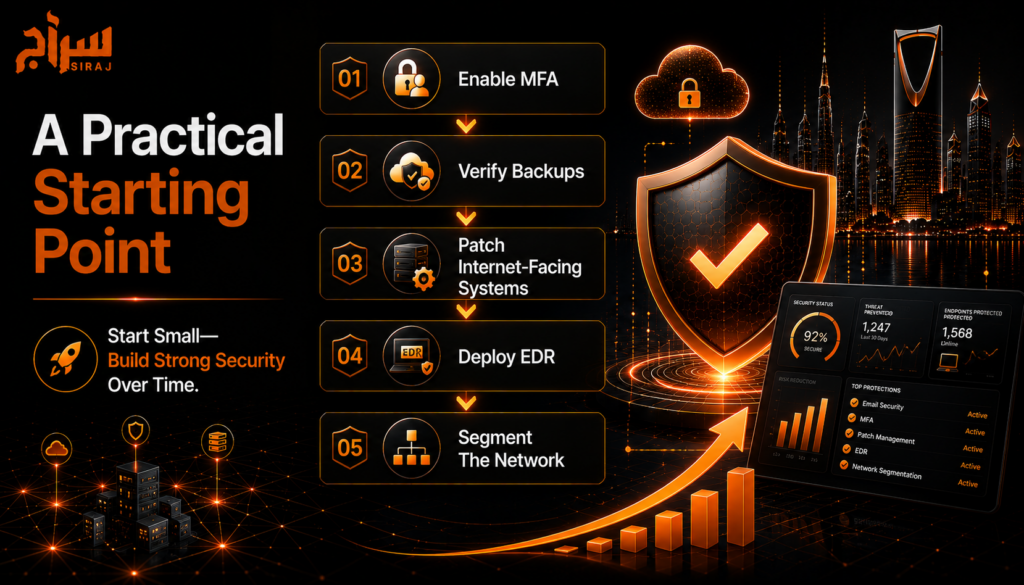
For a Saudi SME assessing where to start, the highest-leverage sequence is: enforce MFA everywhere (highest impact, lowest cost), confirm backups are genuinely isolated and have actually been test-restored recently, patch internet-facing and remote-access systems on a fast cadence, then layer in EDR and network segmentation as the next tier of investment. Each of these closes a specific, well-documented entry or spread mechanism — not a hypothetical one.
Prevention Doesn’t Eliminate Risk — It Changes the Odds
No combination of controls makes an organization immune to ransomware; the goal of prevention is shifting the odds so decisively in your favor that a successful attack becomes rare, and even when something does get through, contained and recoverable rather than catastrophic. Combined with a tested recovery plan for the rare case that does slip through, this is what a genuinely mature ransomware defense looks like — not a single silver-bullet product, but a layered set of fundamentals, consistently maintained.
—
**Want a ransomware readiness assessment across all of these controls?** [Book a free consultation with SirajTech →](/contact)