
“Resilient infrastructure” sounds like something only large enterprises with dedicated infrastructure teams need to worry about. In practice, the businesses that get hurt worst by infrastructure failures are usually mid-sized organizations that grew past what their original setup was designed for — a file server bought three years ago now buckling under twice the staff, a single internet line with no failover, backups that “should” work but have never actually been tested by a real restore. Resilience isn’t about building for a hypothetical enterprise scale; it’s about building infrastructure that fails gracefully instead of catastrophically at the scale you’re actually operating at.
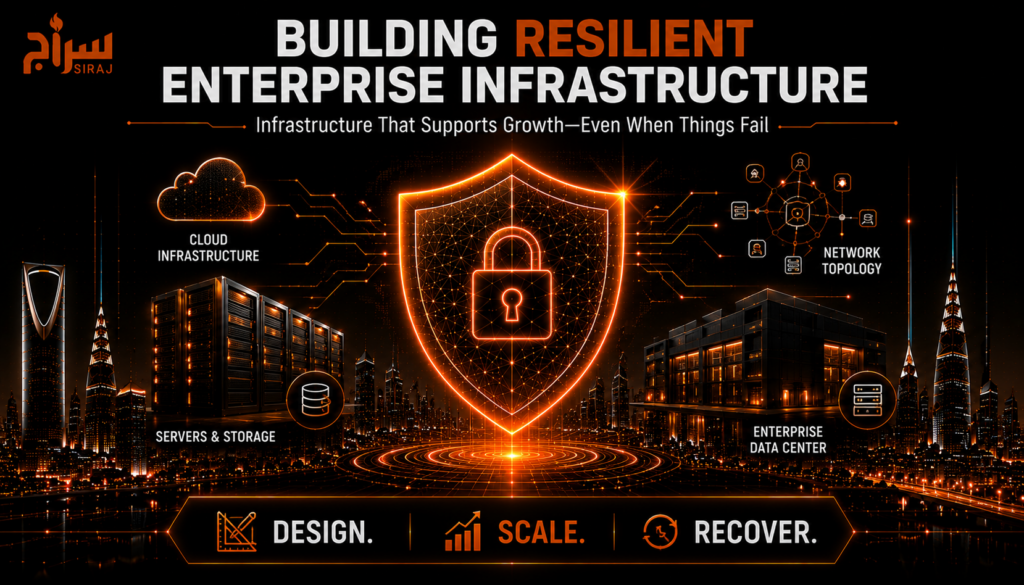
What “Resilient” Actually Means
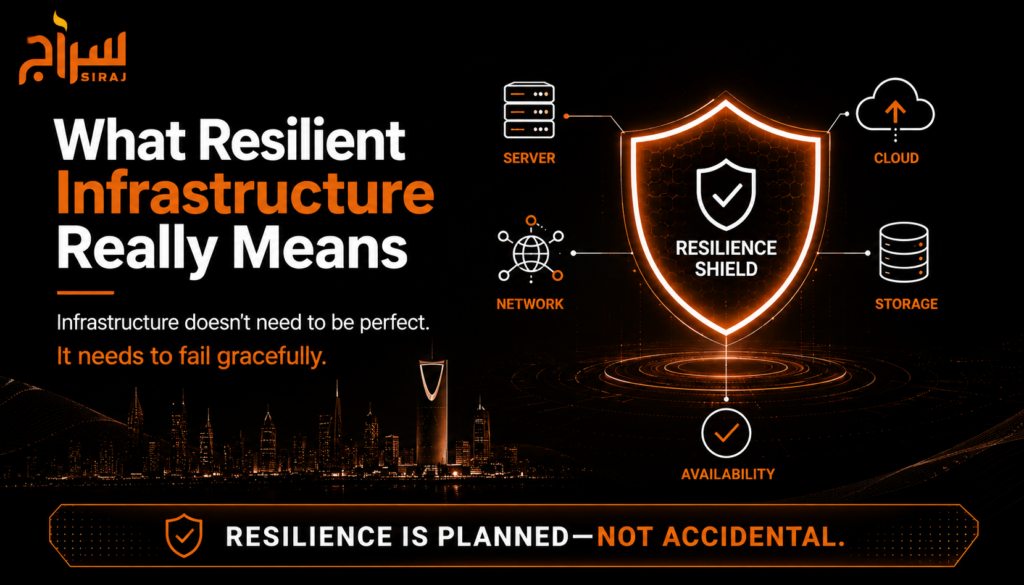
Resilient infrastructure isn’t infrastructure that never fails — every component fails eventually, from hard drives to internet lines to cloud regions. Resilience is the difference between a failure that causes a five-minute blip nobody notices and a failure that takes the business offline for a day. That difference comes almost entirely from decisions made in advance, not from reacting well in the moment.
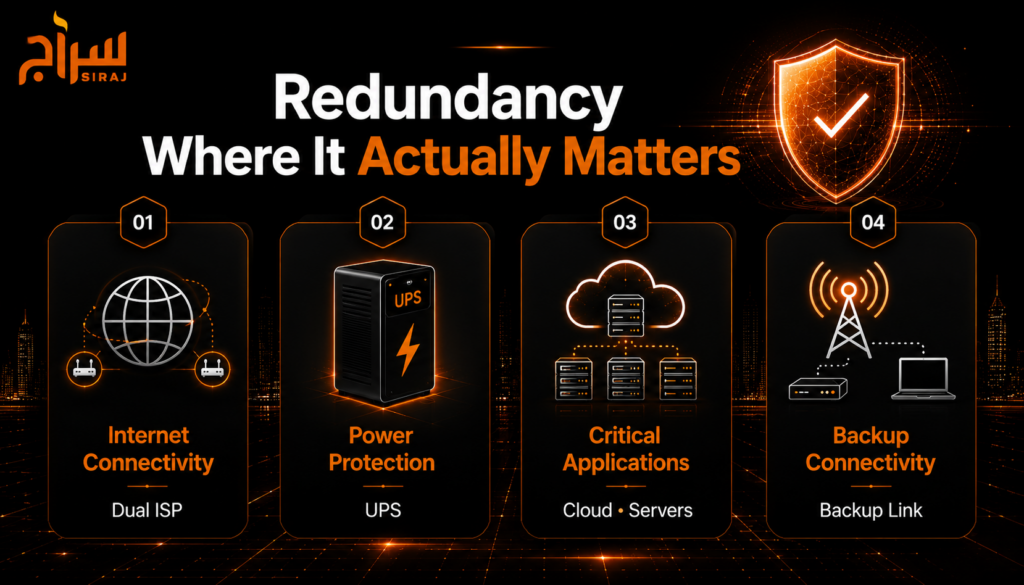
Redundancy Where It Actually Matters
Full redundancy everywhere is neither affordable nor necessary for most businesses. The practical approach is identifying your genuinely critical dependencies and building redundancy specifically around those:
– **Internet connectivity** — a single ISP line with no backup means any outage on that provider’s end is your outage too. A secondary connection (even a lower-bandwidth backup line or a 4G/5G failover) keeps core operations running during an ISP-side failure that’s entirely outside your control.
– **Power** — for on-premises server rooms, a UPS covering the time needed for a graceful shutdown (or a generator, for organizations that truly can’t tolerate downtime) prevents the specific failure mode of hardware corruption from an abrupt power loss, which is often worse than the outage itself.
– **Critical application availability** — for systems the business genuinely cannot function without, understanding whether your hosting (cloud or on-premises) has a realistic recovery time if the primary instance fails, and whether that recovery time is actually acceptable to the business.
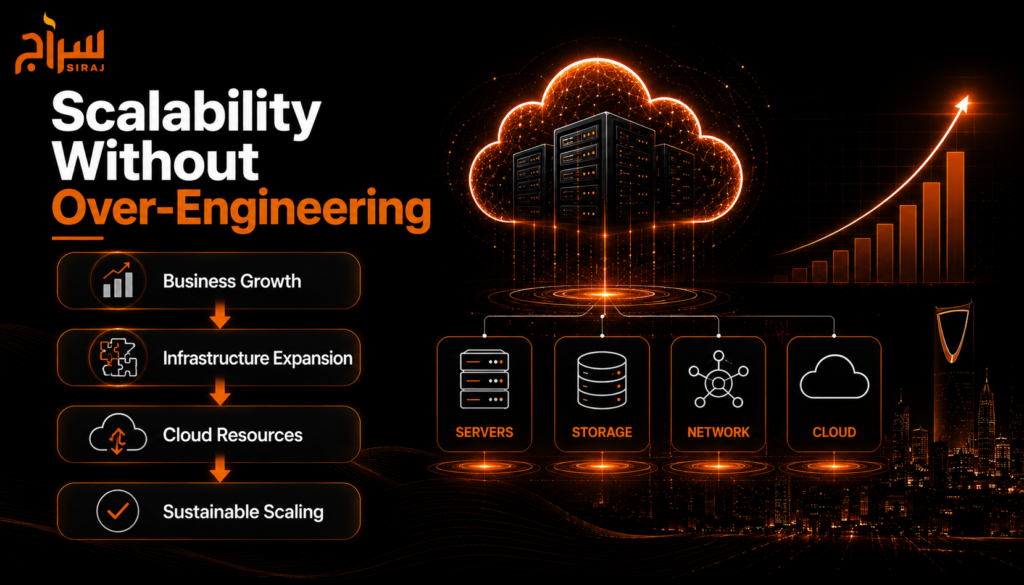
Scalability: Designing for Growth Without Over-Engineering
The opposite failure mode to under-resilience is over-engineering — building enterprise-grade infrastructure for a business that doesn’t need it yet, at a cost that doesn’t make sense for its current size. The practical middle ground is designing for *incremental* scalability: infrastructure that can grow with the business without a disruptive full rebuild every time you cross a growth threshold.
Cloud providers’ own architecture guidance — such as [AWS’s Well-Architected Framework] (https://aws.amazon.com) — has made this meaningfully easier than it was a decade ago — compute and storage that scale on demand mean a growing business doesn’t need to guess its infrastructure needs three years out and buy for that guess today. The tradeoff is that cloud scalability without cost governance quietly turns into unpredictable, growing monthly bills — a different failure mode worth planning for, not avoiding cloud infrastructure altogether.
Data Centers, Cloud, or Hybrid: Choosing What Fits
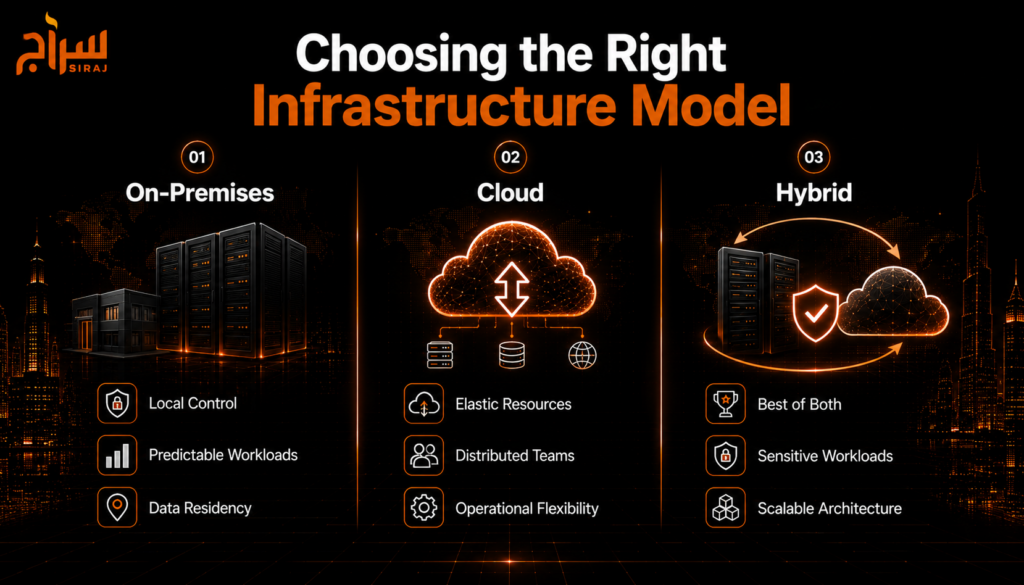
There’s no universally correct answer between on-premises infrastructure, cloud infrastructure, and a hybrid mix — the right choice depends on the specific business:
– **On-premises** remains a reasonable choice for organizations with specific data residency requirements, existing capital investment in hardware, or workloads with very predictable, stable resource needs.
– **Cloud infrastructure** suits businesses with variable or growing workloads, distributed teams, and a preference for operational expenditure over capital expenditure — and increasingly, cloud providers with a presence in the Kingdom address data residency concerns that used to push Saudi businesses toward on-premises by default.
– **Hybrid approaches** — keeping specific sensitive or latency-critical workloads on-premises while running everything else in the cloud — are increasingly common precisely because they let a business match each workload to its actual requirements rather than forcing a single infrastructure decision across the whole business.
Monitoring: You Can’t Fix What You Can’t See
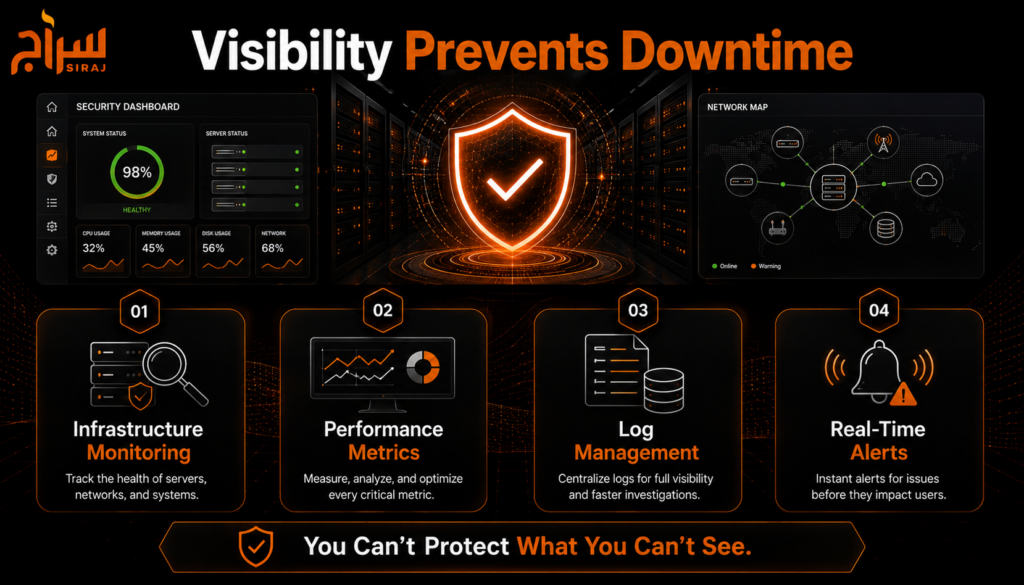
Infrastructure resilience isn’t just architecture — it’s visibility. A properly monitored environment surfaces a failing disk, a saturating network link, or a memory leak in a critical application *before* it becomes an outage, not after. Basic infrastructure monitoring — uptime checks, resource utilization alerts, log aggregation — is inexpensive relative to the cost of an undetected slow degradation turning into a hard failure at the worst possible moment.
The Real Test: Has Anyone Actually Tried to Break It?
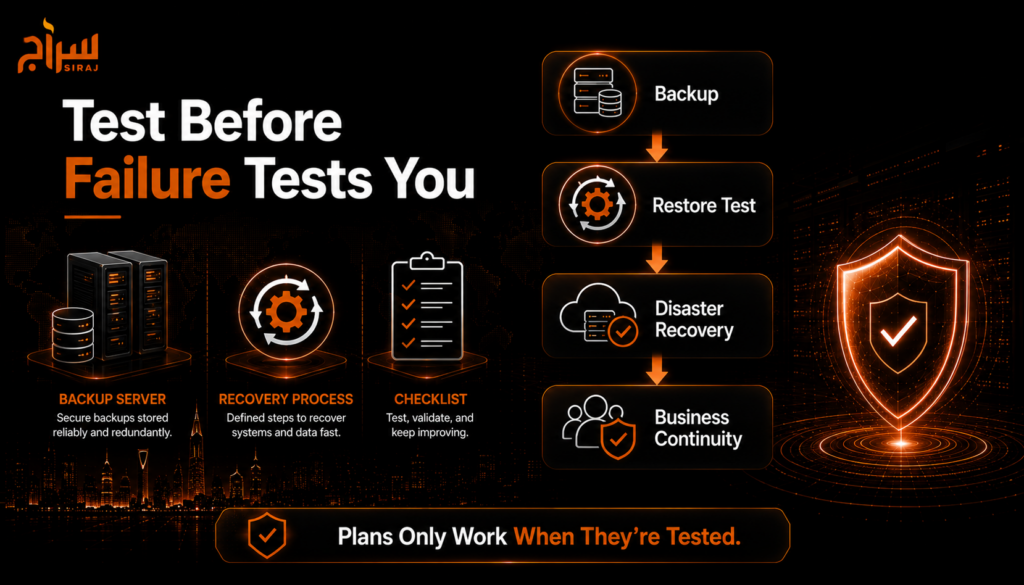
The uncomfortable truth about most infrastructure resilience plans is that they’ve never actually been tested. A documented disaster recovery plan that has never been rehearsed, a backup that has never been test-restored, a failover connection that has never actually been failed over to — these are resilience plans on paper, not in practice, and the gap between the two is usually only discovered during a real incident, which is the worst possible time to discover it.
Building Infrastructure That Matches Your Business
Resilient enterprise infrastructure isn’t a one-time project — it’s an ongoing discipline of matching your architecture to your actual risk tolerance and growth trajectory, testing the assumptions behind it periodically, and closing the gaps that testing reveals. Getting the fundamentals right — redundancy where it matters, scalability without over-engineering, and genuine visibility into what’s happening — gives a Saudi business infrastructure that supports growth instead of quietly becoming the thing that breaks under it.

—
**Not sure if your infrastructure would hold up under real failure conditions?** [Book a free infrastructure resilience assessment with SirajTech →](/contact)