FortiGate Firewall: What Saudi SMEs Need to Know
Most small and mid-sized Saudi businesses still think of a firewall the way it worked fifteen years ago: a box that blocks or allows traffic based on IP address and port number. That model hasn’t been enough to stop a modern attack in a long time. Today’s threats hide inside encrypted web traffic, disguise themselves as legitimate application requests, and move laterally through a network the moment one employee clicks the wrong link. This is the gap Next-Generation Firewalls (NGFWs) like Fortinet’s https://www.fortinet.com FortiGate were built to close — and it’s why FortiGate has become one of the most widely deployed firewall platforms among Saudi SMEs, particularly those pursuing Aramco CCC certification or NCA ECC compliance, both of which expect meaningfully more than a basic packet filter at the network edge.
What Makes a Firewall “Next-Generation”
A traditional firewall inspects traffic at Layers 3 and 4 of the network stack — source, destination, port, protocol. It has no visibility into what’s actually inside that traffic. A next-generation firewall inspects at Layer 7, the application layer, which means it can see and act on the actual content and context of traffic passing through it. In practice, this is the difference between a firewall that can tell you “this is HTTPS traffic on port 443” and one that can tell you “this is an unapproved file-sharing application tunneling over port 443, initiated by a workstation that shouldn’t have access to it.”
FortiGate delivers this through a set of integrated capabilities rather than a single feature:
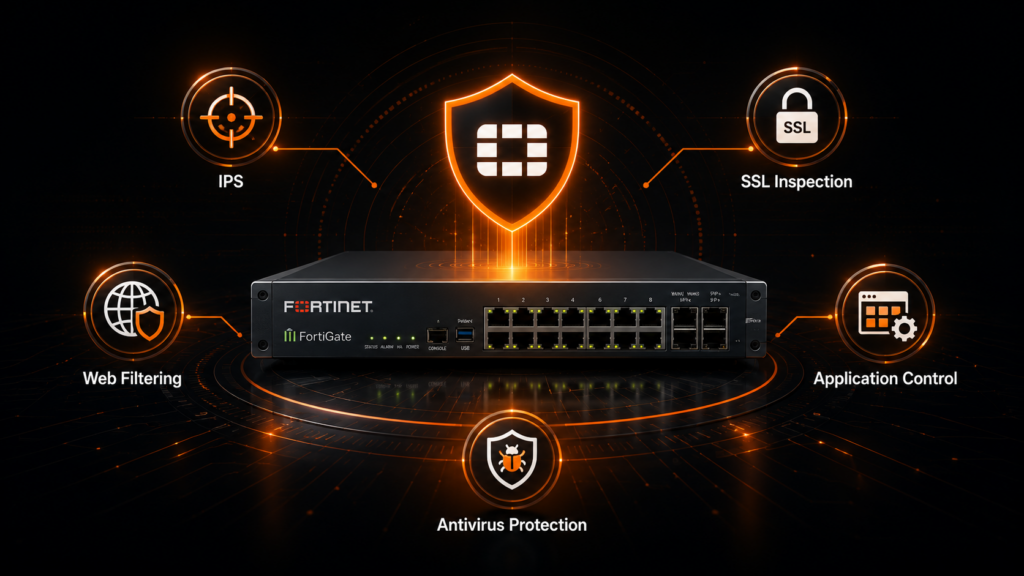
– **Intrusion Prevention System (IPS):** inspects traffic in real time against a continuously updated database of attack signatures and behavioral patterns, blocking exploit attempts before they reach a vulnerable system.
– **SSL/TLS inspection:** decrypts and inspects encrypted traffic (with appropriate certificate handling) since the overwhelming majority of both legitimate traffic and modern malware now travels over encrypted channels — a firewall that can’t see inside HTTPS is effectively blind to most of what crosses it.
– **Web filtering:** blocks access to known-malicious, phishing, and inappropriate categories of websites at the network level, rather than relying solely on endpoint protection to catch what a user already reached.
– **Application control:** identifies and can restrict specific applications regardless of the port they use, closing the “unapproved app tunneling over an open port” gap traditional firewalls miss entirely.
Unified Threat Management (UTM): Why It Matters for Saudi SMEs
Unified Threat Management is the licensing and architecture model that bundles IPS, antivirus scanning, web filtering, application control, and (on most FortiGate models) a VPN gateway into a single appliance and management console, rather than requiring separate boxes — and separate vendor contracts, firmware update cycles, and support tickets — for each function.
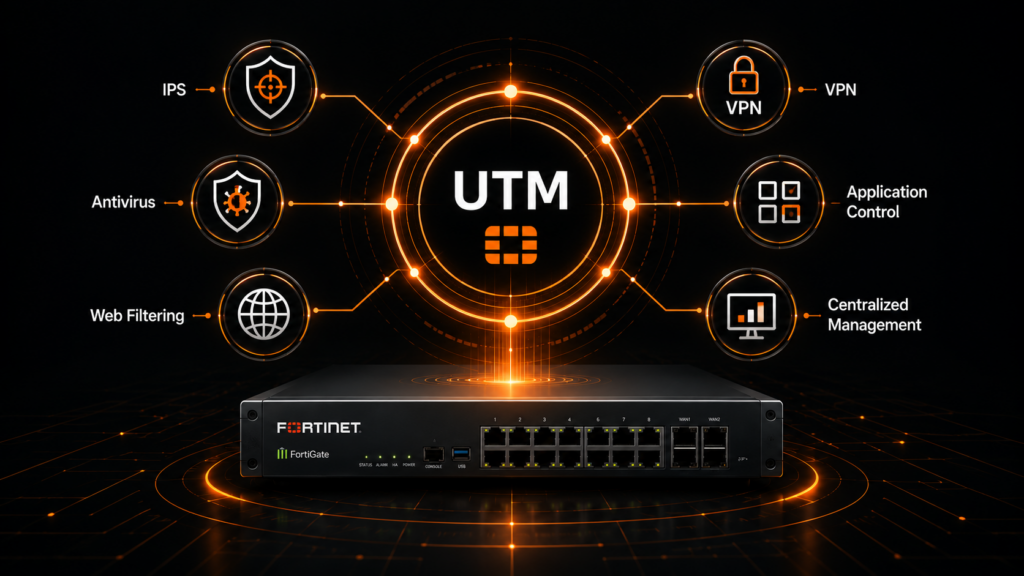
For a Saudi SME without a dedicated in-house network security team, this consolidation is the practical argument for UTM, not a marketing one. Every additional standalone security appliance is another system that needs patching, another log to review, another vendor relationship to manage, and another potential misconfiguration. A single, properly sized and configured FortiGate UTM appliance gives a lean IT team (or an outsourced managed security provider) one console, one policy set, and one vendor to hold accountable — while still delivering enterprise-grade protection across each of those functions.
Right-Sizing: The Mistake Most Businesses Make
The single most common FortiGate deployment mistake among Saudi SMEs isn’t a missing feature — it’s an undersized appliance. Fortinet’s FortiGate line spans a wide range of throughput and concurrent-session capacities, and enabling deep packet inspection, SSL inspection, and IPS simultaneously consumes meaningfully more processing capacity than simple packet filtering. A firewall sized only for “internet bandwidth” without accounting for the overhead of full UTM inspection will either silently degrade in performance under load or get reconfigured — often quietly, and often by frustrated staff — to disable the very inspection features that justified the purchase in the first place.
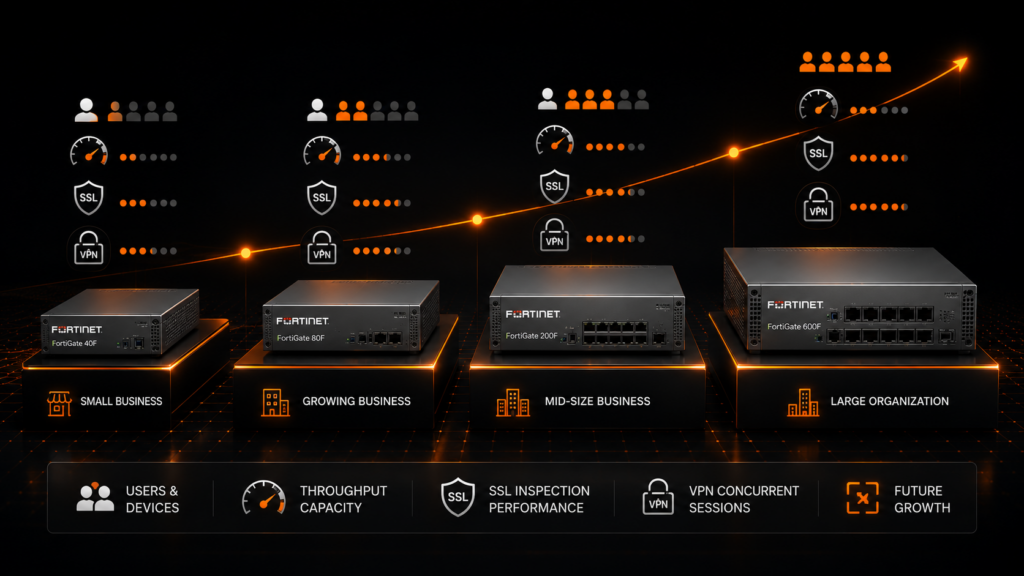
Proper sizing accounts for:
- Current and near-term future internet bandwidth
- – Number of concurrent users and devices
- – Whether SSL inspection will be enabled for all traffic or only specific categories
- – VPN concurrent-connection requirements, particularly for organizations supporting remote or field staff
Common Configuration Gaps
Beyond sizing, the recurring pattern in firewall audits at Saudi organizations is not an absent feature but a feature purchased and never properly turned on. The most frequent gaps:
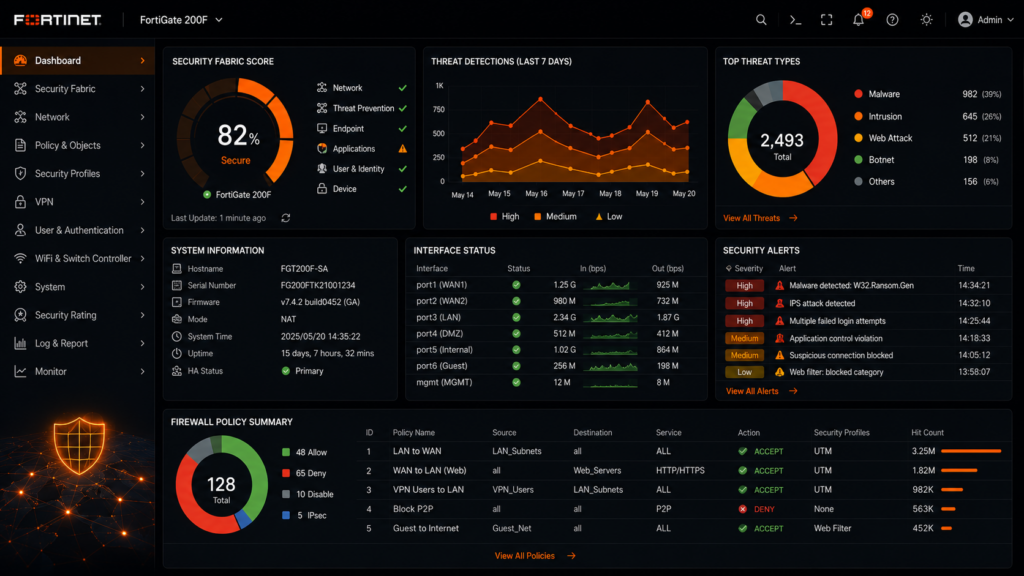
- 1. **Default or overly broad firewall policies** left in place from initial setup, allowing far more traffic than the business actually requires.
- 2. **SSL inspection disabled** because it wasn’t configured with proper certificate distribution to endpoints, so administrators turned it off rather than fix the underlying trust configuration — leaving the majority of modern traffic uninspected.
- 3. **IPS running in “monitor only” mode** rather than actively blocking, often left over from an initial tuning period and never switched to active enforcement.
- 4. **No formal change-management process** for firewall rules, so exceptions accumulate over years without review, each one a small crack in the policy.
- 5. **Firmware left unpatched** because updates require a maintenance window nobody has scheduled — despite Fortinet regularly releasing security patches for newly disclosed vulnerabilities.
Why This Matters for CCC and NCA ECC Compliance
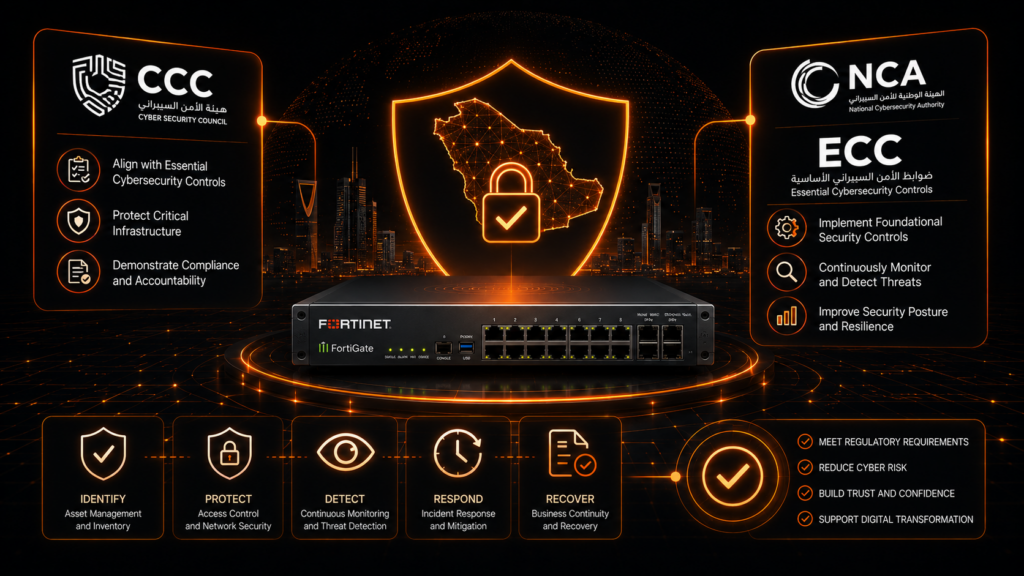
Both the Aramco CCC program and the National Cybersecurity Authority’s Essential Cybersecurity Controls expect demonstrable network security controls, not just a firewall’s physical presence. An auditor reviewing your environment will typically want to see the actual policy configuration, evidence of regular log review, and proof that intrusion prevention and web filtering are active and enforcing — not simply installed. A FortiGate appliance that has never had its default configuration reviewed will not satisfy this expectation, regardless of how capable the hardware itself is.
Getting FortiGate Right
A properly deployed FortiGate — sized for real traffic conditions, with SSL inspection and IPS actively enforcing rather than merely logging, application control tuned to the organization’s actual approved software list, and a documented change process for firewall rules — gives a Saudi SME a genuinely strong network security foundation. The hardware is capable; the gap is almost always in deployment discipline and ongoing management, not the platform itself.
If your current firewall was installed once and left alone since, that’s worth a second look — not because the hardware failed, but because a firewall’s protection degrades in practice the moment its configuration stops being actively managed.
*SirajTech is a Fortinet-authorized partner and manages FortiGate deployments for Saudi businesses pursuing Aramco CCC certification, NCA ECC alignment, and day-to-day network protection. For further reading, Fortinet publishes official NGFW and UTM documentation directly on its corporate site — a useful primary reference alongside this guide.*
**Need help for FortiGate Firewall across your organization?** [Contact SirajTech for expert assistance →](contact)