
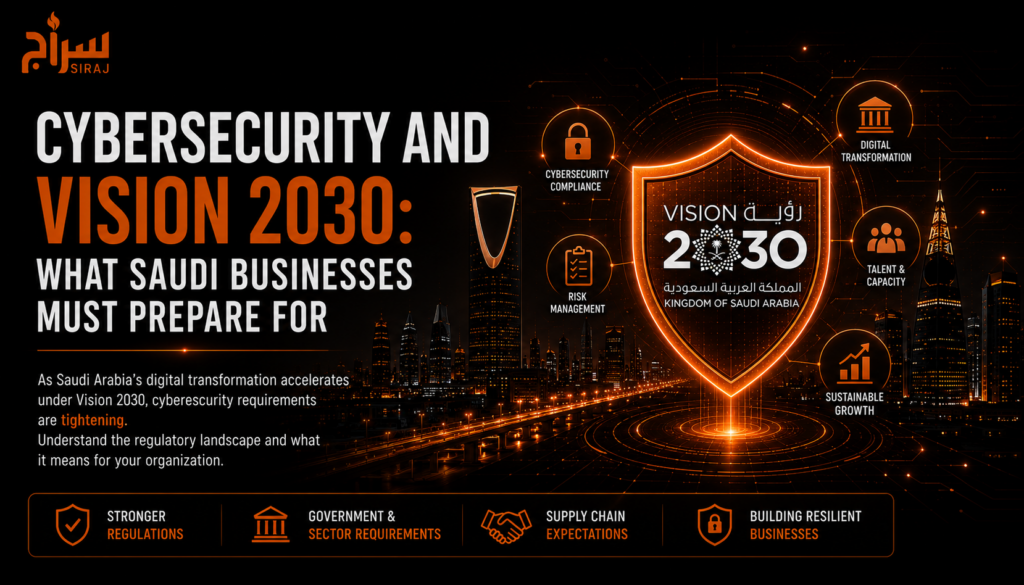
Saudi Arabia’s Vision 2030 https://www.vision2030.gov.sa is usually discussed in terms of economic diversification, giga-projects, and the growth of non-oil sectors — and rightly so.
Less discussed, but arguably just as consequential for the ordinary Saudi business, is what that same transformation means for cybersecurity expectations.
A national economy moving rapidly toward digital government services, a growing critical-infrastructure and giga-project ecosystem, and deeper integration with global trade and finance is, by necessity, an economy where cybersecurity regulation tightens in parallel
And where doing business with government entities, major contractors like Saudi Aramco, or increasingly digitized supply chains means meeting a rising baseline of security expectations, whether or not “cybersecurity” was ever part of your core business.
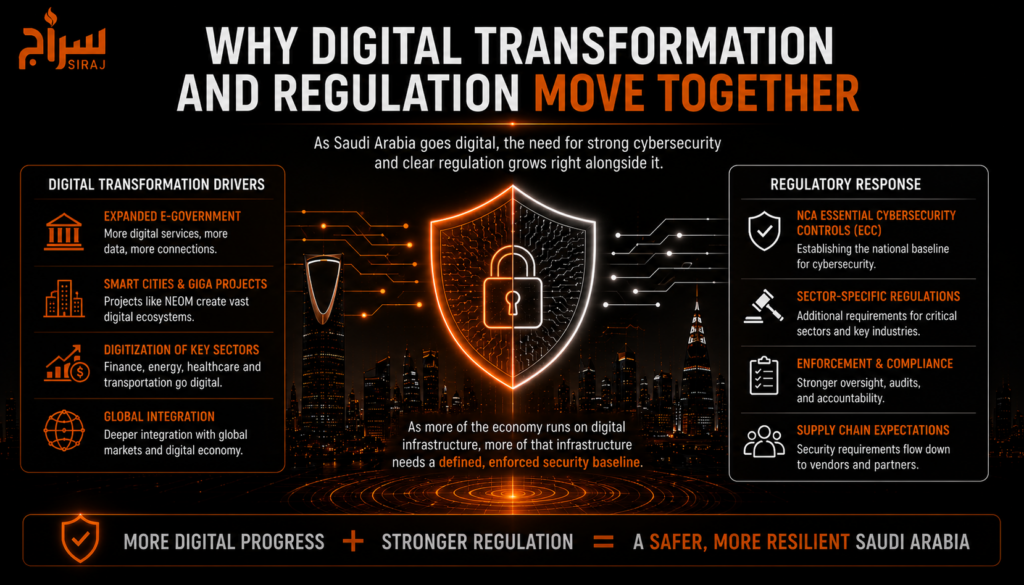
Why Digital Transformation and Regulation Move Together
Every one of Vision 2030’s flagship digital initiatives — expanded e-government services, smart-city infrastructure in giga-projects like NEOM, deeper digitization of the financial sector
increases the attack surface of national infrastructure and the businesses connected to it.
The National Cybersecurity Authority’s steady expansion of regulatory frameworks over the past several years, most visibly the Essential Cybersecurity Controls (ECC), is the direct regulatory counterpart to that digital expansion: as more of the economy runs on digital infrastructure, more of that infrastructure needs a defined, enforced security baseline.
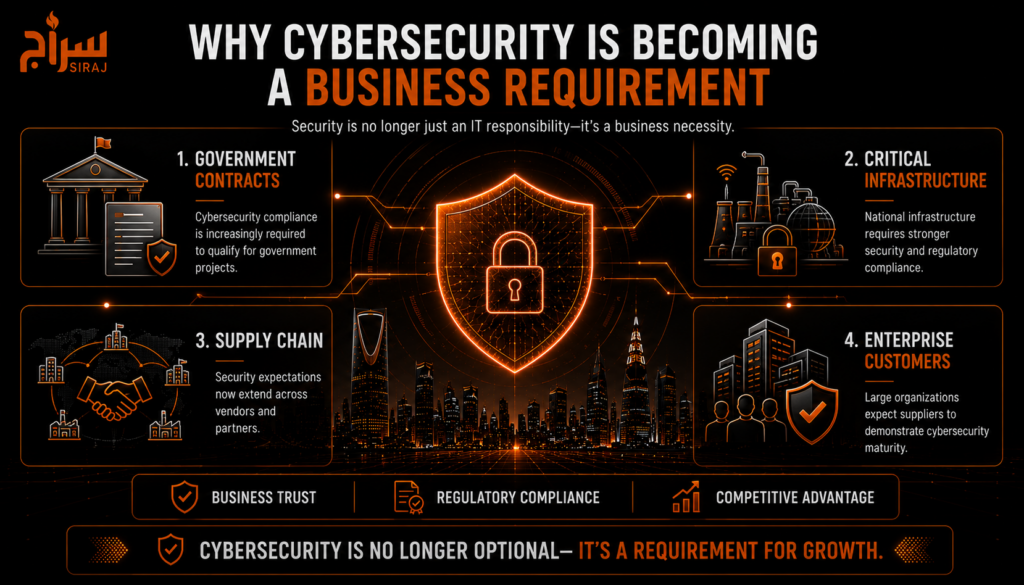
For a Saudi business, this means cybersecurity compliance is increasingly not an optional differentiator but a de facto requirement for participating in large parts of the economy government contracts, work with regulated sectors like finance and energy, and vendor relationships with major Saudi enterprises like Aramco, which maintains its own vendor cybersecurity certification (CCC/SACS-002) specifically because national and sector-level frameworks alone don’t cover every requirement Aramco’s own risk profile demands of its supply chain.
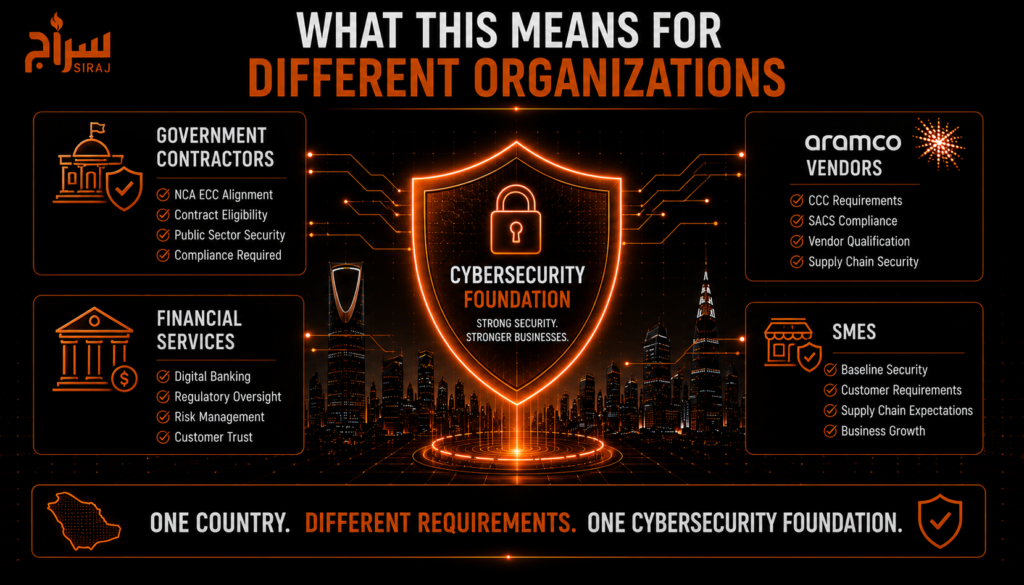
What This Looks Like in Practice for Different Business Types
**Government contractors and their supply chains** — NCA ECC alignment, and in some sectors additional sector-specific requirements, are increasingly a precondition for contract eligibility, not a nice-to-have.
**Vendors and contractors to Saudi Aramco and similar large enterprises** — CCC/SACS-002 certification (or equivalent enterprise-specific vendor security programs) functions as a gatekeeping requirement; without it, a vendor cannot be onboarded or paid, regardless of the value or size of the work.
**Financial services and fintech** — operating in one of the most actively regulated digital sectors under Vision 2030’s financial-sector diversification goals, with cybersecurity requirements from sector regulators layered on top of NCA’s national baseline.
**SMEs generally** — even businesses with no direct government or Aramco relationship increasingly encounter security expectations indirectly, as larger customers and partners push baseline security requirements down their own supply chains — a pattern global markets have already gone through and one Saudi Arabia’s growing digital economy is now following.
The Talent and Capacity Gap
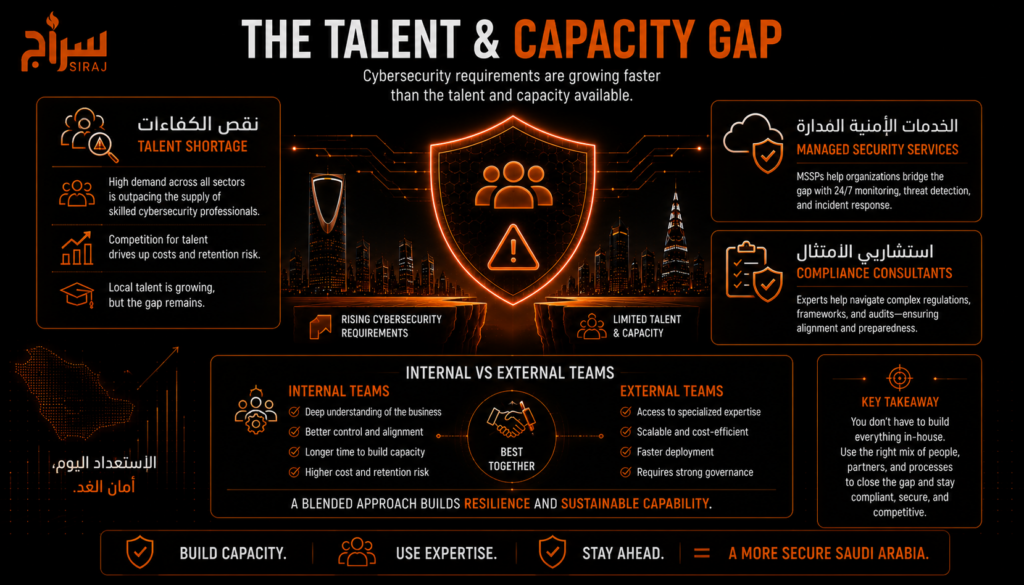
One of the less-discussed dimensions of Vision 2030’s cybersecurity implications is workforce capacity. As regulatory requirements expand faster than the domestic pool of experienced cybersecurity professionals grows, many Saudi organizations — particularly SMEs without the budget for a full in-house security team — face a genuine capability gap between what compliance now requires and what they can build internally. This is a significant part of why managed security services and compliance-focused consultancies have grown quickly in the Saudi market: not as a luxury, but as the practical way most mid-sized organizations can meet a rising regulatory bar without building an internal security function from scratch.
Preparing for What’s Coming, Not Just What’s Required Today
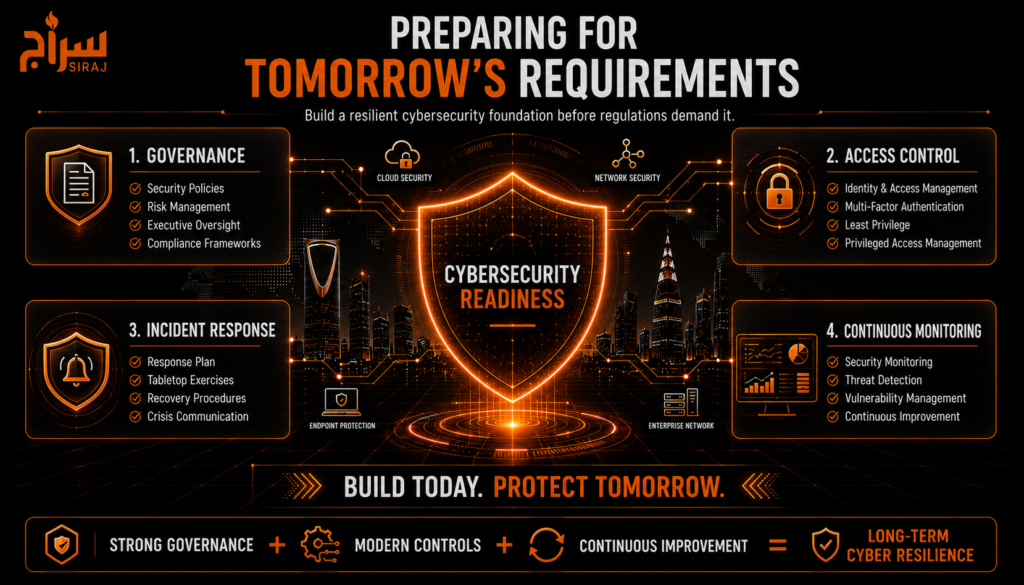
Because Vision 2030 is a multi-year national program, and NCA’s regulatory frameworks have historically been updated and expanded rather than left static, the businesses in the strongest position aren’t the ones that meet today’s minimum requirement exactly — they’re the ones building a genuine security foundation (documented governance, real access control, tested incident response, ongoing monitoring) that can flex to meet whatever the next round of regulatory expansion requires, rather than needing a from-scratch compliance project every time a framework updates.
Practically, this means:
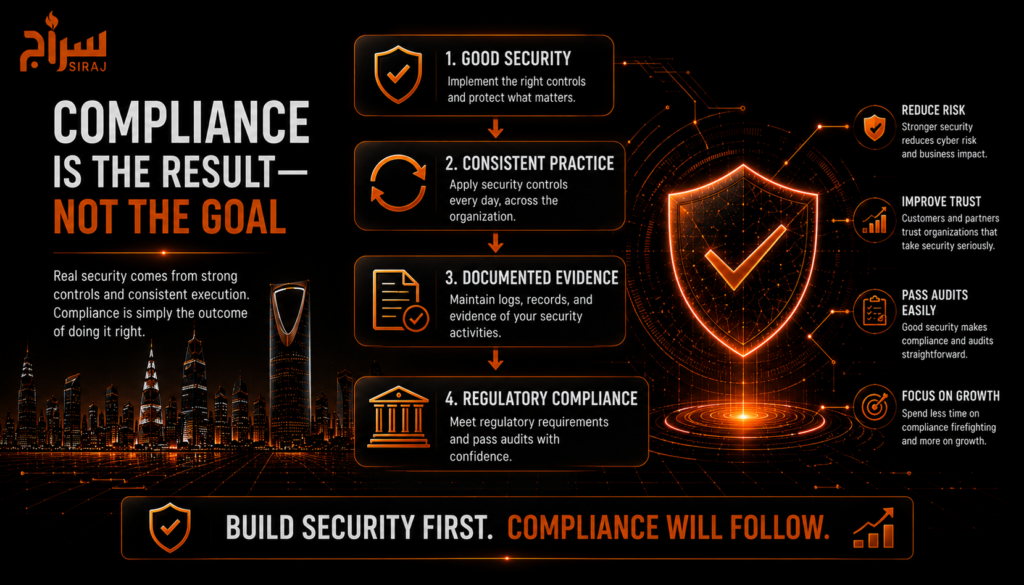
– **Treating compliance as a byproduct of good security practice, not the goal itself** — an organization with genuinely strong access control, monitoring, and incident response will find meeting NCA ECC, CCC, or any future framework a documentation exercise rather than a technical rebuild.
– **Building relationships with the regulatory landscape early**, rather than waiting until a specific contract or client relationship forces the issue — understanding NCA ECC and relevant sector requirements before they become a blocking dependency on a deal.
– **Investing in staff awareness alongside technical controls** — a persistent theme across every Saudi cybersecurity framework, reflecting that human behavior remains the most common initial access point regardless of how mature technical controls become.
The Opportunity Side of This
It’s worth stating plainly: this regulatory tightening is not simply a compliance burden to be minimized. Saudi Arabia’s push toward a more secure digital economy is also a genuine competitive differentiator opportunity — businesses that can credibly demonstrate strong cybersecurity posture win government contracts, Aramco vendor relationships, and increasingly security-conscious enterprise customers that their less-prepared competitors cannot. As Vision 2030 continues to reshape which businesses get access to the largest, most valuable contracts in the Saudi economy, cybersecurity maturity is becoming one of the deciding factors in who gets to compete for them at all.
Getting Ahead of It
For a Saudi business asking “how much of this actually applies to us,” the honest answer is: probably more, and sooner, than it currently feels like it does — either directly through a regulatory requirement or a client relationship, or indirectly through a customer or partner who will eventually ask. Building a real security foundation now, rather than reactively when a specific contract or audit forces the question, is consistently the less expensive and less disruptive path.
—
*SirajTech helps Saudi businesses build cybersecurity programs that satisfy today’s specific compliance requirement — CCC, NCA ECC, or both — while building a foundation that scales with the Kingdom’s continued digital and regulatory transformation under Vision 2030.*Contact